Victorian Landcare Magazine - Spring, Issue 92
For many farmers, balancing productivity with environmental responsibility has been an ongoing challenge.
For Kate Mirams and Peter Neaves, the answer has been to stop treating those goals as competing priorities and instead recognise that healthy soils, resilient pastures, clean water and profitable farming are deeply connected.
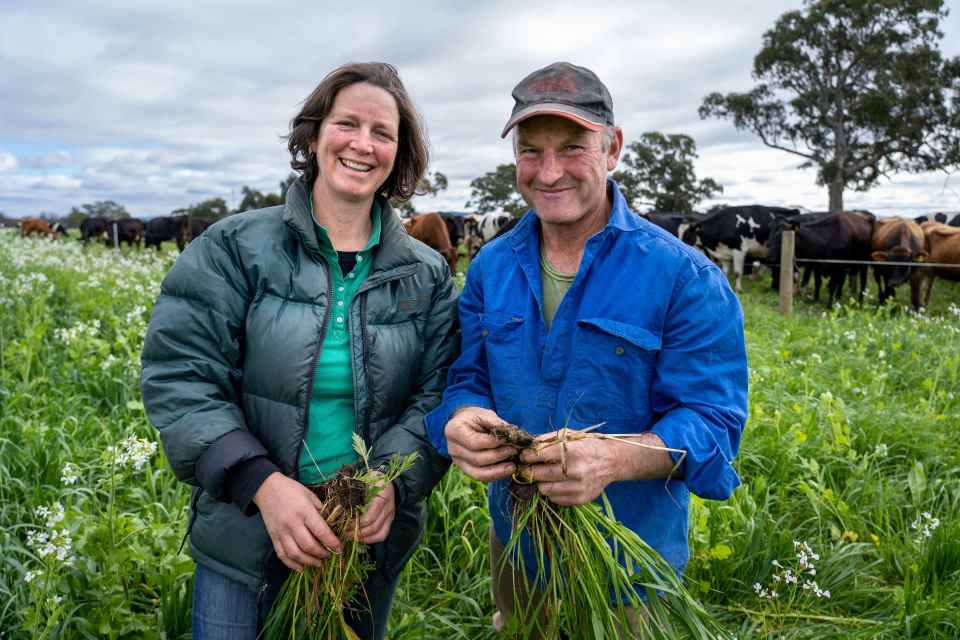
Farming at Newry in Gippsland, Kate Mirams and Peter Neaves have operated their dairy business, Neaves Mirams Ag, since 2003, milking about 320 cows.
In 2018 they began asking questions that many dairy farmers on irrigated properties are now exploring; could they grow the same amount of pasture while reducing their dependence on synthetic fertilisers? And could they rebuild soil health more rapidly in landscapes that had been heavily modified through laser grading?
Rather than rely on theory, they turned their farm into a living laboratory. With support from the West Gippsland Catchment Management Authority, Agriculture Victoria and later GippsDairy, they established demonstration trial sites comparing conventional dairy farming systems with regenerative approaches.
Seven years later, the results have attracted attention from farmers, researchers and industry leaders across Australia and New Zealand.
Their changes were significant. Cultivation was phased out. Herbicide use, chemical seed treatments and synthetic fertiliser applications were reduced.
In their place came multispecies pastures, biological seed treatments, natural soil amendments, beneficial microbes and direct drilling techniques.
Grazing management also changed to encourage deeper root growth, greater plant mass and more consistent groundcover.
At the heart of the project is soil health.
Rather than focusing solely on feeding plants, Kate and Peter shifted their attention to building living soils. Diverse pasture species, including grasses, legumes and herbs such as chicory and plantain support beneficial soil biology while creating stronger, deeper root systems.
These deeper roots improve soil structure, increase organic matter and help plants access moisture during dry conditions.
Monitoring on the farm revealed a striking difference. Roots in regenerative paddocks were accessing water at depths of up to 60 centimetres, compared with around 30 centimetres in conventionally managed paddocks.
Improved infiltration and water storage have enhanced drought resilience while reducing runoff and improving irrigation efficiency.
The couple’s research focus has now turned to water retention, nutrient losses and water-use efficiency, to better understand these benefits.
The environmental gains have been matched by strong commercial outcomes.
Despite substantially reducing synthetic nitrogen inputs, the business has maintained one of the highest pasture consumption rates within its benchmarking group.
It has also ranked among the top 25 per cent for return on assets in the Victorian Dairy Farm Monitor Project, demonstrating that lower input costs and improved nutrient efficiency can support profitability without sacrificing production.
Above ground, the farm tells an equally compelling story.
Extensive revegetation along Newry Creek has restored native vegetation, protected waterways and created shade for livestock.
These plantings help conserve endangered ecological vegetation communities including floodplain riparian woodland, plains grassland and billabong wetland aggregate.
By fencing waterways and protecting streambanks, Kate and Peter have reduced erosion, improved water quality and strengthened ecological health across the property.
Their commitment to biodiversity extends beyond native vegetation.
Diverse pastures create habitat for insects and other beneficial organisms, while healthy soils support complex microbial communities below ground.
Ecological Outcome Verification assessments have recorded improvements in water cycling, nutrient cycling, energy flow and biodiversity, providing independent evidence that the farm’s regenerative practices are enhancing ecosystem function.
Importantly, Kate and Peter have not kept these lessons to themselves.
A defining feature of their work has been a commitment to rigorous measurement and knowledge sharing.
Rather than adopting regenerative practices on faith, they established side-by-side trial paddocks and monitored soil health, pasture growth, root depth, moisture levels, profitability and ecological outcomes.
This evidence-based approach has strengthened confidence among other farmers considering similar changes.
Their leadership extends well beyond the farm gate. Peter has served on the board of the Maffra and Districts Landcare Network for eight years.
He is acting chair, and has previously served as treasurer, while Kate joined the board two years ago.
Together they have hosted field days, farm walks and demonstrations, sharing practical lessons about regenerative farming with producers across the region.
Interest in their work continues to grow. They have presented at Dairy Australia’s Grounds for Growth conference, spoken at the Quorum Sense conference in New Zealand, featured in a Soils for Life case study and hosted the launch of Soils for Life’s Dairy Resilience Project.
Their story has also reached a wider audience through ABC’s Landline, radio interviews, newspaper articles and social media.
The significance of their achievement lies not only in what they have done on one Gippsland dairy farm, but in what it demonstrates for Australian agriculture more broadly.
Kate and Peter have shown that regenerative farming can support productive, profitable agriculture while improving biodiversity, water quality and soil function.
Their approach offers a practical example of how farming systems can become more resilient, environmentally responsible and economically sustainable.
Kate and Peter’s journey began with a simple question about reducing dependence on synthetic inputs.
Seven years later, that question has evolved into a model of sustainable agriculture that is inspiring farmers well beyond Newry and helping shape a more resilient future for Australian farming.